Sudan Hopeful of AU Suspension Review, Slams Sanctions Impact
[ad_1]
Janury 9, 2025 (ADDIS ABABA) – Sudan’s government expressed optimism Thursday regarding a potential reassessment of its suspended membership in the African Union (AU), while criticizing the ongoing sanctions for hindering humanitarian assistance in the country.
The AU suspended Sudan in October 2021 following a military coup led by General Abdel Fattah al-Burhan, which ousted the civilian-led transitional government. The AU’s Peace and Security Council (PSC) has maintained that the suspension will remain in place until the effective restoration of a civilian-led authority.
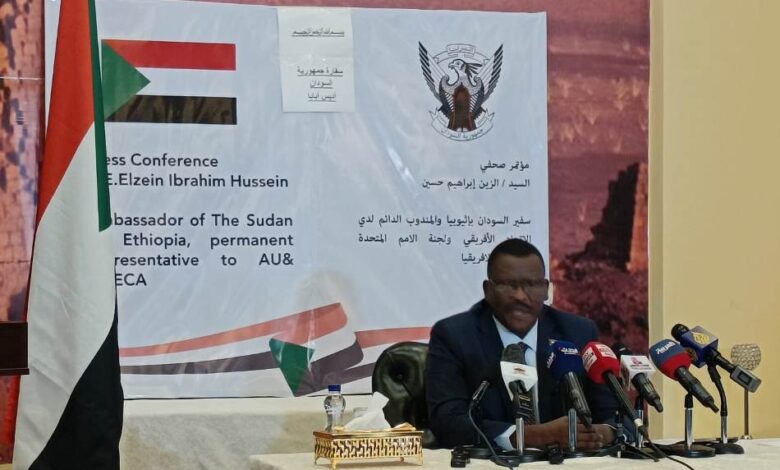
Speaking at a press conference in Addis Ababa, Sudan’s Ambassador to Ethiopia, Al-Zain Ibrahim, stated that the PSC’s recent visit to Port Sudan had yielded “positive indicators” and that the Sudanese government anticipates a new evaluation of the country’s status.
Ambassador Ibrahim argued that the suspension has weakened the AU’s role in Sudan and inadvertently empowered actors seeking to destabilize the country. He emphasized that Sudan continues to engage with the AU through various technical committees despite the suspension.
While acknowledging that Sudan has not yet received an invitation to the upcoming AU Summit in February, Ambassador Ibrahim highlighted his acceptance as Sudan’s representative to the AU as evidence that the country’s membership has not been fully revoked.
Humanitarian Concerns
Ambassador Ibrahim raised the impact of the suspension on vital technical sectors as a key point of contention. He urged the AU to lift restrictions on areas such as healthcare, agriculture, and programs related to children and cross-border diseases, arguing that these sanctions exacerbate Sudan’s humanitarian situation.
“The AU speaks of a humanitarian crisis, yet the state is being punished,” Ibrahim said, questioning why Sudanese health officials are barred from participating in technical meetings. “This exclusion even affects communities that need support,” he said.
The Ambassador also addressed the difficulties faced by Sudanese nationals residing in Ethiopia. He acknowledged the complex procedures and high fees associated with visa renewals, particularly following recent policy changes by Ethiopian authorities.
He stated that the Sudanese government is actively working to alleviate the burdens on Sudanese families in Ethiopia resulting from these measures.
Regional dynamics and the conflict
Ambassador Ibrahim called on the Intergovernmental Authority on Development (IGAD) to “correct its position” towards Sudan and encourage its return to the regional bloc.
Furthermore, he reiterated accusations against the United Arab Emirates for allegedly supporting the Rapid Support Forces (RSF), a paramilitary group currently engaged in a conflict with the Sudanese Armed Forces. He also urged Chad to close its airports, which he claimed are used to supply the RSF.
Reflecting on the transitional period
The Ambassador offered a critical assessment of the previous transitional period, suggesting that internal conflicts between the civilian and military components hampered progress on key reforms, such as establishing the legislative council and constitutional court.
He asserted that most civilian political forces are now aligned with General al-Burhan.
Finally, Ibrahim claimed that RSF leader Mohamed Hamdan Dagalo (Hemetti) initiated the current conflict on April 13, 2023, two days earlier than widely reported, and that the army’s delayed response was intended to protect civilians. The conflict was reported to have begun on April 15.
[ad_2]
Source link